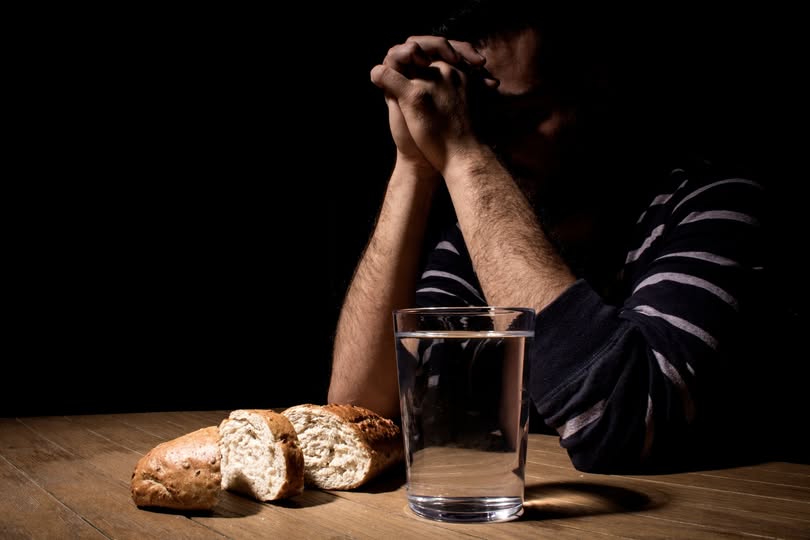
Within the culture of the Soldiers of St. Michael the Archangel, many men have discovered real spiritual fruit through fasting. Periods of hunger, restraint, and bodily discipline can sharpen prayer, quiet the mind, and benefit the body. As a Fraternity we affirm this. Fasting, when rightly practiced, has always been a powerful tool in the Christian life, and we do not discourage men from taking it seriously.
But seriousness requires order. Discipline without wisdom quickly becomes distortion. Ascetic practices that are not governed by humility, obedience, and discernment risk drifting away from repentance and toward self-regard. What begins as sacrifice can quietly turn into performance. What begins as prayer can harden into ego-driven asceticism.
We seek a form of fasting that is austere but rightly ordered, intense but restrained. The goal is not heroic suffering, spiritual extremism, or personal distinction. The goal is repentance, clarity, and fidelity to the teachings of the Church.
Why Do We Fast?
PAENITEMINI (Paul VI, On Fasting and Abstinence)
One fasts or applies physical discipline to “chastise one’s own soul,”(17) to “humble oneself in the sight of his own God,”(18) to “turn one’s face toward Jehovah,”(19) to “dispose oneself to prayer,”(20) to “understand” more intimately the things which are divine,(21) or to prepare oneself for the encounter with God.(22) Penance therefore—already in the Old Testament—is a religious, personal act which has as its aim love and surrender to God: fasting for the sake of God, not for one’s own self.
True penitence, however, cannot ever prescind from physical asceticism as well. Our whole being in fact, body and soul, (indeed the whole of nature, even animals without reason, as Holy Scripture often points out) (46) must participate actively in this religious act whereby the creature recognizes divine holiness and majesty.
The necessity of the mortification of the flesh also stands clearly revealed if we consider the fragility of our nature, in which, since Adam’s sin, flesh and spirit have contrasting desires.(47) This exercise of bodily mortification-far removed from any form of stoicism does not imply a condemnation of the flesh which sons of God deign to assume.(48)
On the contrary, mortification aims at the “liberation”(49) of man, who often finds himself, because of concupiscence, almost chained (50) by his own senses. Through “corporal fasting”(51) man regains strength and the “wound inflicted on the dignity of our nature by intemperance is cured by the medicine of a salutary abstinence.”(52)
X. 1. It is strongly desired that bishops and all pastors of souls, in addition to the more frequent use of the sacrament of penance, promote with zeal, particularly during the Lenten season, extraordinary practices of penitence aimed at expiation and impetration.
Penance and Petition
Expiation: Atonement for some wrongdoing. It implies an attempt to undo the wrong that one has done, by suffering a penalty, by performing some penance, or by making reparation or redress.
Impetration: One of the fruits of prayer and good works, especially one of the four ends of the Eucharistic Sacrifice. Impetration with right disposition and the fulfillment of prescribed conditions invariably obtains from God what is asked of him, provided it is to our spiritual advantage. It is ensured petition. (Catholic Dictionary)
Penance and petition. That’s why we fast. That is our faith. It is important to clarify that from the start when we address the topic of fasting.
Fasting is not a novelty, a health fad or a modern invention. It is one of the oldest disciplines of the Christian life, practiced by the Saints, commanded by Scripture, and prescribed by the Church. When fasting is practiced rightly, it brings order to the whole man, body, mind, and soul.
The Body of Man
Modern science has confirmed what the Church has long prescribed. Certain periods of fasting can have a positive effect on the physical body. Fasting gives the digestive system rest, reduces systemic inflammation, and activates processes of cellular repair such as autophagy, the body’s method of removing damaged cells and regenerating healthier ones. Energy use becomes more efficient.
Saint Paul speaks plainly of this bodily discipline when he writes, “I chastise my body and bring it into subjection, lest after preaching to others I myself should be disqualified” (1 Corinthians 9:27). This is not self-abuse. It is stewardship. The body is good, but it must be governed.
The Intellect of Man
Fasting also sharpens the mind. Hunger strips away distraction. Decisions simplify. Attention consolidates. What modern men experience during fasting has deep biological roots. The human brain evolved under conditions where hunger demanded clarity, alertness, and focus. A dull or distracted mind did not survive.
As food intake is reduced, mental noise often quiets. Thought becomes more deliberate. Awareness increases. This is not accidental. The mind was designed to become more attentive when resources are scarce. A clearer mind becomes a more truthful mind. A disciplined mind becomes capable of discernment, deeper prayer and contemplation.
The Soul of Man
Spiritually, fasting purifies the soul and prepares fertile ground for prayer. Scripture consistently unites the two. Christ Himself fasted before entering His public ministry. He taught that certain battles are not overcome by prayer alone, but by prayer joined to fasting (Matthew 17:21).
Saint Augustine writes that fasting “cleanses the soul, raises the mind, subjects one’s flesh to the spirit, renders the heart contrite and humble.”
When the body is restrained and the mind is quieted, the soul encounters fewer obstacles. Desire is simplified. The will becomes less divided. Prayer deepens because the man himself has been brought into right order with Christ.
It is a preparation for communion with God.
What Fasting does the Church Prescribe for the Laity?
Before men begin to add additional asceticism to their spiritual life, they must know what the Church prescribes for laymen. Asceticism begins with obedience, not invention. The Church, in her wisdom, binds lightly but deliberately, requiring fasting only where it is truly formative and universally attainable.
The Catechism of the Catholic Church teaches that the precepts of the Church are meant to “guarantee the faithful the indispensable minimum in the spirit of prayer and moral effort” (CCC 2041). Fasting is part of that minimum, not as an extreme, but as a shared act of penance and discipline.
The Church requires fasting on Ash Wednesday and Good Friday for all Catholics between the ages of 18 and 59, unless exempted for reasons of health.
According to the Church’s discipline, fasting means eating one full meal and two smaller meals, which together do not equal a full meal, and abstinence from meat on these days.
This is a concrete bodily discipline, modest in scope but universal in application. The Catechism notes:
“The seasons and days of penance in the course of the liturgical year are privileged moments of the Christian’s penitential practice.” (CCC 1438)
The Church does not prescribe extended or extreme fasting for the laity because her concern is not intensity, but fidelity. The Church has established a baseline of obedience that unites the faithful across circumstances, cultures, and states of life. It establishes the minimum discipline expected of a faithful Catholic.
However, the Church does not forbid additional fasting, nor does it discourage voluntary penitential practices undertaken with proper discernment and spiritual direction.
What Fasting does the Church Prescribe for Religious Brothers?
Many laymen are drawn to fasting because it feels monastic. This instinct is not wrong. The monastic life has always stood as a witness of disciplined prayer, restraint, and ordered sacrifice. But if laymen wish to imitate monastic practices, they must first understand what the Monastic Orders of our Church require.
The Rule of Saint Benedict, which has shaped Western monasticism, is deliberately moderate. Benedict structures fasting not around deprivation for its own sake, but around sustainability, prayer, and labor. During penitential seasons, monks typically eat one meal per day, often taken later in the afternoon or evening. Meals are simple. Portions are restrained. Meat is limited or excluded. But meals are not completely eliminate
Saint Benedict explicitly warns against excess, instructing abbots to adjust fasting according to strength, labor, and circumstance, “so that the strong may desire more, and the weak may not draw back.”
The Cistercians, and later the Trappists, intensified Benedictine simplicity but did not abandon his restraint. Their fasting emphasizes plain food, limited portions, and long periods without meat or rich fare. Meals may be reduced to one per day during Lent, but nourishment remains regular.
The Franciscans embraced poverty and fasting, but always within obedience to the Church. Saint Francis fasted frequently, but he also rebuked brothers who fasted imprudently or sought distinction through extremes. Francis insisted that the body be treated as a “brother donkey” that must be worked but not beaten to death. His rule prioritizes humility, fraternity, and charity over severity.
Orders following the Rule of Saint Augustine emphasize moderation, communal discipline, and fasting according to ability. Augustine teaches that fasting is good when it produces humility and patience, but harmful when it breeds comparison or pride.
Across these traditions and others, a consistent pattern emerges. Fasting is frequent, but not extreme. Meals are simplified, not eliminated. Discipline is communal and obedient, not self-directed. Asceticism is sustained over decades, not intensified in bursts.
What Fasting does the Eastern Catholic Tradition Prescribe?
It is also worth noting that the Eastern Catholic Churches, which share the spiritual and ascetical heritage of Orthodoxy while remaining fully Catholic, retain a more rigorous and comprehensive fasting discipline than is common in the modern Latin Church
In many Eastern Catholic traditions Wednesdays and Fridays are observed year-round as fast days. Great Lent involves extended periods of strict fasting, with limitations on meat, dairy, oil, and wine. Additional fasting seasons exist throughout the liturgical year, including fasts before major feasts. This discipline is undeniably demanding. It reflects an ancient rhythm of life shaped by restraint and repentanc
Yet even here, the pattern remains consistent with the broader monastic tradition. Fasting is frequent and sustained, not extreme or episodic. Meals continue. Nourishment is maintained. The emphasis is placed on obedience to the rule, humility of spirit, and perseverance over time
This example reinforces the same principle seen throughout the Church, East and West: authentic asceticism is ordered, communal, and governed by wisdom. It is rigorous, but never reckless.
Discernment and Guidance
The fact we must acknowledge as a Fraternity is that the Church has never prescribed lay or religious men to engage in prolonged, multi day, water-only fasting as a norm of lay or religious life.
If monks, living under vows, obedience, and spiritual fatherhood, are not required to engage in prolonged fasting, then laymen must be especially cautious in how they imitate monastic discipline. Any lay asceticism that claims monastic inspiration must first submit itself to monastic wisdom and tradition.
Where extraordinary fasting occurred in the lives of saints, it was personal, exceptional, and never imposed as a rule. The Church venerates their holiness but does not necessarily prescribe their unique method
Fasting is a tool. When it is used rightly, it forms the man in Christ. When it is misused, it distorts him. It is easy to confuse intensity with holiness. Intensity feels holy because it is costly. Pain, hunger, endurance, and deprivation feel like proof of our love for God.
But asceticism loses its order when it is no longer governed by humility, obedience, and discernment. What begins as discipline can quietly become self-directed, self-justifying, and self-referential. The Church has always warned that spiritual practices, when detached from right order, can become instruments of pride rather than repentance.
Ego-Driven Asceticism
Ego driven asceticism often disguises itself as zeal. It seeks distinction rather than repentance. It escalates rather than submits. It measures success by difficulty rather than fruit. This form of asceticism feels heroic. It produces a sense of spiritual superiority, even if unspoken. The man begins to qualify his spiritual worth by what he endures.
The Church Fathers repeatedly caution that extremes attract the ego. Saint John Cassian teaches that fasting becomes dangerous when it exceeds obedience, writing that “excessive fasting is no virtue if it produces pride or contempt for others” and warns that fasting without discernment “becomes a snare of pride rather than a remedy for sin.” Fasting that seeks recognition, comparison, or internal validation has already shifted its center away from God.
Scrupulosity
Another cause of disordered asceticism is scrupulosity. The man becomes fixated on precision, perfection, rule-keeping, and self-monitoring. Discipline becomes a means of control rather than surrender. Nothing he does is ever good enough. No amount of penance will set him right with God.
When a man’s attention is consumed by managing his discipline, he is no longer attending to God. The practice becomes the focus, not love of God.
Rightly Ordered Care for the Body
Ascetic disciplines must account for the wellbeing of the body. The Christian faith does not treat the body as disposable. It treats it as a gift entrusted to our care. Any discipline that ignores the body’s limits is not spiritual courage, but imprudence
The Church has always insisted that fasting be undertaken according to one’s strength and condition. Modern medical science, though speaking a different language, arrives at a similar conclusion.
Contemporary research generally agrees that short-term fasting can be safe and beneficial for healthy adults when properly undertaken. Fasts in the range of 24 to 36 hours are commonly studied and widely practiced without medical supervision, provided hydration is maintained and physical exertion is moderated.
Within this window the body shifts from glucose to fat and ketones for energy. Insulin levels drop. Inflammatory markers may decrease. Cellular repair mechanisms increase. Mental clarity often improves. These effects help explain why fasting can feel sharpening and stabilizing when practiced responsibly.
Fasting from 24 to 72 hours (1-3 days) is generally considered safe for healthy adults, so long as certain precautions are taken. Day three is where physiological benefits, cellular renewal and mental clarity peak. However, breaking a 3-day fast improperly can be more dangerous than the fast itself. Refeeding syndrome can cause life-threatening electrolyte shifts, particularly in people who are malnourished or have extended their fast beyond 72 hours
As fasting extends beyond 72 hours the physiological risks increase significantly and unpredictably. At this stage, individual variability becomes decisive. What one man tolerates, another may not.
Potential complications include electrolyte imbalances, particularly sodium and potassium. Drops in blood pressure, leading to dizziness or fainting. Heart rhythm disturbances in susceptible individuals. Excessive fatigue or weakness. Increased risk during refeeding. These risks are not speculative. They are well-documented in clinical settings. For this reason, extended fasts beyond this range are not generally recommended without medical supervision, which typically includes monitoring hydration status, blood pressure, heart rhythm, and electrolyte levels.
Certain conditions make extended fasting especially risky, including diabetes or blood sugar disorders, gout, heart or kidney disease. Those using blood pressure or cardiac medications should be cautious. Any condition requiring regular medication or nutritional intake should be taken into consideration. Men who have any history of eating disorders should also use particular discernment.
In these cases, fasting beyond basic Church prescriptions should never be undertaken without professional medical guidance.
The Vision of the SSMA
Zeal and intensity are not the enemy. But intensity without order becomes self-destructive. As a Fraternity we are not saying that longer, more intense fasts are morally wrong or without benefit, physically or spiritually. The Church has never taught that. What she has taught, consistently, is that sacrifice without discernment becomes disorder.
This is why the test of ascetic discipline is not its difficulty, but its fruit. A fast that produces humility, clarity, charity, and peace is rightly ordered. A fast that produces pride, anxiety, comparison, scrupulosity, or is harmful to the body, is not.
This is the vision that must govern fasting within the Soldiers of St. Michael. We affirm discipline. We affirm sacrifice. We affirm the desire to go deeper. But we reject asceticism that is driven by ego, detached from wisdom, or isolated from obedience. Strength is not proven by excess. Holiness is not measured by endurance alone. The goal is not to feel heroic, but to be rightly ordered with God.
The SSMA Fasting Protocol
A Rule of Discipline and Discernment
The Soldiers of St. Michael affirm fasting as a central discipline of repentance, prayer, and self-mastery. This protocol exists to ensure that fasting within the fraternity remains rightly ordered, obedient to the Church, attentive to the body, and free from ego-driven excess. What follows establishes a common rule for the fraternity. It defines what is expected, what is permitted, and where discernment and pastoral oversight are required.
The Ordinary Discipline
Throughout Lent and formal periods of fraternity spiritual exercises (Exodus 90, The Path of the New Man) all members of the SSMA are asked to observe fasting on Wednesdays and Fridays at a minimum level consistent with the Church’s prescriptions.
Men who wish to observe a 24–36 hour water only fast (dinner to dinner, or dinner to following breakfast) on Wednesdays or Fridays may do so voluntarily, provided this does not interfere with health, work, or family obligations. Such fasts are considered reasonable and within the bounds of prudent lay asceticism and are entirely optional.
The Initiatory Fast at the Beginning of Lent
At the beginning of Lent, the SSMA prescribes a 24-hour water only fast for all able-bodied members. This fast is intentionally demanding but attainable. It serves as an initiatory act, marking the entrance into the Lenten season with penance, seriousness and resolve.
This requirement presumes no prior fasting experience beyond the ordinary discipline and is therefore set at a level that is challenging but safe for the majority of men.
Optional Extended Lenten Fast
For men who are already formed in fasting and who feel genuinely called to deeper discipline, the SSMA permits an optional extended water only fast of up to three days, traditionally leading into Ash Wednesday. This fast is entirely voluntary. It is not required for fraternity standing. It is not a measure of commitment or status.
Men who undertake this fast should do so only if they have already practiced shorter fasts and understand their own physical and spiritual limits. The purpose of this fast is deeper repentance and prayer, not endurance for its own sake. No man should feel pressured, compared, or judged for not participating in this optional fast.
Clear Boundaries and the Test of Obedience
The SSMA places a firm boundary on fraternity-prescribed fasting. No water only fast longer than three day (72 hrs.) is prescribed or encouraged by the fraternity. Any fasting beyond this protocol, whether longer in duration or more severe in restriction, falls outside the ordinary rule of the SSMA.
If a man desires to pursue fasting beyond these limits, he is required to seek the counsel and blessing of the fraternity’s Spiritual Father, Father Michael. We must ensure that such fasting remains rightly ordered and accept correction or restraint if advised by our Spiritual Father.
A Pastoral Note on Health and Exemptions
The Church has always recognized that fasting is not a universal obligation in all circumstances. Men who are ill, recovering from injury, managing chronic conditions, taking necessary medications, or whose mental health would be negatively impacted by fasting are fully exempt from fasting obligations. This exemption is not a failure, a weakness, or a lesser form of participation.
Saint Francis de Sales reminds us that “God desires obedience and mercy, not sacrifice.” A man who abstains from fasting out of prudence and humility is not less obedient than one who fasts. He may, in fact, be more so.
Men who are exempt are encouraged to substitute another penitential practice appropriate to their condition. The goal remains repentance and conversion of heart, not bodily deprivation at all costs.
No man should feel compelled to disclose private medical information in order to justify restraint. Discernment in these matters is personal and respected.
A Closing Exhortation
The Soldiers of St. Michael the Archangel exist to form men who are strong, disciplined, and faithful. Fasting is one tool among many in this work. When practiced rightly it sharpens prayer and strengthens the virtue of temperance. It increases a man’s capacity for discipline and self-mastery.
Let your sacrifice be rightly ordered. Let your zeal be governed by wisdom. Do not seek extremes. Seek the discernment of the Holy Spirit. The measure of your fasting is not how long you endure hunger, but whether your heart becomes more humble, more patient, more attentive to God and more full of love for others.
And may Saint Michael the Archangel be our protection against the snares of the devil, guard us in humility, obedience, and strength.
Ferrum Acuit Ferrum
 Soldiers of Saint Michael the Archangel